

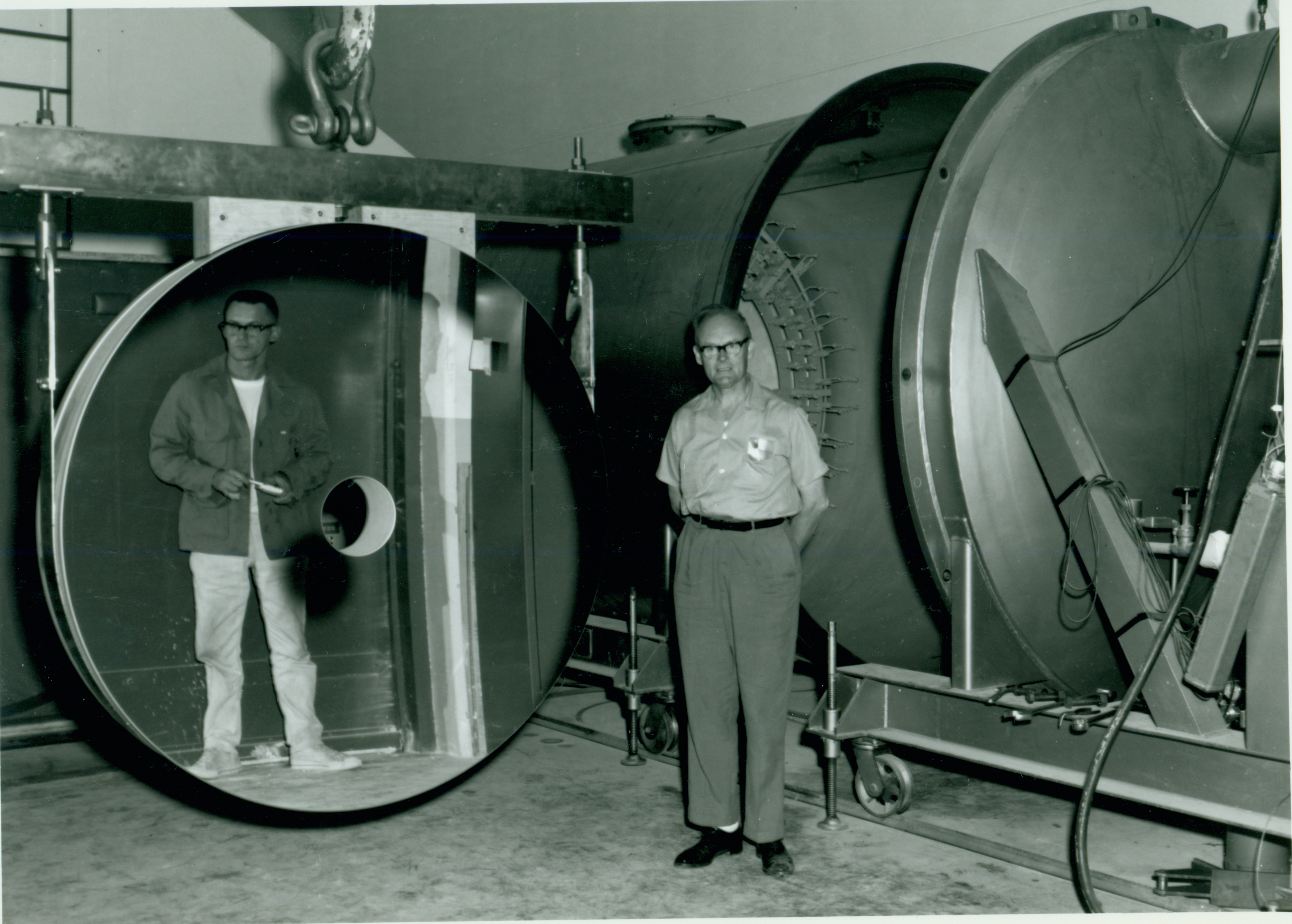
Ewen Whitaker
It really dates back to 1955, when I went to a meeting of the International Astronomical Union in Dublin, Ireland. I’d heard that Gerard Kuiper was going to be there, which was fortunate because I knew that he was interested in the Moon and planets. He put out this little memo: “I’m interested in making an atlas with the best pictures that have been taken from the Mt. Wilson, the Pic-du-Midi observatories, and anyone interested in giving some guidelines, please get in touch after the meeting.”
Well, I got back home and I thought, “This is good, I’m interested in the Moon as a sideline, let me write to Kuiper.” So I wrote him a long letter in longhand, and I said: This is good, I’d be happy to help, I don’t approve of this idea, let’s have the sheets of paper this way around rather than this way, and of course he wrote back. I was the only one who wrote to him out of all the astronomers at that meeting. Four hundred astronomers, but not one was interested in the Moon. I was the only one.
In 1957, I had all these pictures of the Moon I’d been taking with a telescope in Texas, with the 82-inch. [Kuiper said] “Can you come out for a month? I can pay for you to come out for a month and print up all the negatives of the Moon that I’ve taken.”
I was at the Greenwich Observatory in those days in Herstmonceux in Sussex, and I’d just got a young baby there, or the wife had. I said, “Okay, we’ll come out for a month and print out your pictures.”
So out I went, and it was rather funny because in the London Airport, Sputnik 1 had just gone up and there were big banner headlines: Sputnik 1, the Russians, the Space Race. I got a copy of the newspaper and took it on the overnight flight. In the morning we landed in Chicago and met Kuiper—he came in from Yerkes to pick me up at the airport—and I gave him the paper and he said, “Oh, I haven’t even heard about this. This is big news.”
Dale Cruikshank
After Percival Lowell wrote all these crackpot books about Mars, planetary science had no reputation and nobody wanted to touch the field with a ten-foot pole. By the fifties, there were only two people in the field of any note. One of them was Gerard Kuiper and the other was Harold Urey, who had already won the Nobel Prize in chemistry. The two of them actually for a while were both at the University of Chicago. Urey went off to UC San Diego and Kuiper came here to Arizona, and essentially started two competing schools in planetary sciences.
Alan Binder
Kuiper started to develop the Lunar and Planetary Laboratory down here. I believe he came down in 1960, because I had one more year to get my bachelor’s. I don’t remember exactly when he came down, but at that time the University was all between the wall. You know, the remnants of the basalt wall? It was a great time. It was not very well known in those days.
William Hubbard
It was known was the “Loony-Lab.” We old timers still affectionately refer to it as the Loony-Lab. But in those days it was dismissed by many astronomers as the Loony-Lab, a place where you had rather eccentric people who were under the sway of a dictator, namely Gerard Kuiper who was not particularly enlightened in his approach to things. I think that was very unfair. We revere Kuiper now, but there was a tendency to dismiss him in those days. So it was a definite gamble to come here.
Robert Strom
Very, very little was known about the Moon. We had hardly any data at all. And yet Kennedy announced in 1961 that we were going to send men to the Moon. At that time I was studying images from a geological point of view. I’d heard that Gerard Kuiper had moved his group from Yerkes to the University of Arizona, and opened up the Lunar Lab in 1960. I thought that’d be a great place to work. I came in the spring of 1963 and started here.
At that time the push was for the Moon, although Kuiper and his colleagues were also looking at Mars and other planets. But this was the only place at that time that studied planets, a whole laboratory dedicated to the study of the Moon and planets.
John Lewis
Because of all the observatories around, this was the place, of all places on Earth, where you could get to see any working astronomer from anywhere as he passed through town, once a year at least. So it was a great place for making contacts not just in Tucson, but all over the place.
Charles Wood
The first place I worked was in the temporary buildings. They had buildings that were made in World War II, with sort of hemispherical roofs, you know, curved roofs. They were still there when I got there in the sixties. That’s where the first Lunar Laboratory, where we did the mission and the photographs.