

John Lewis
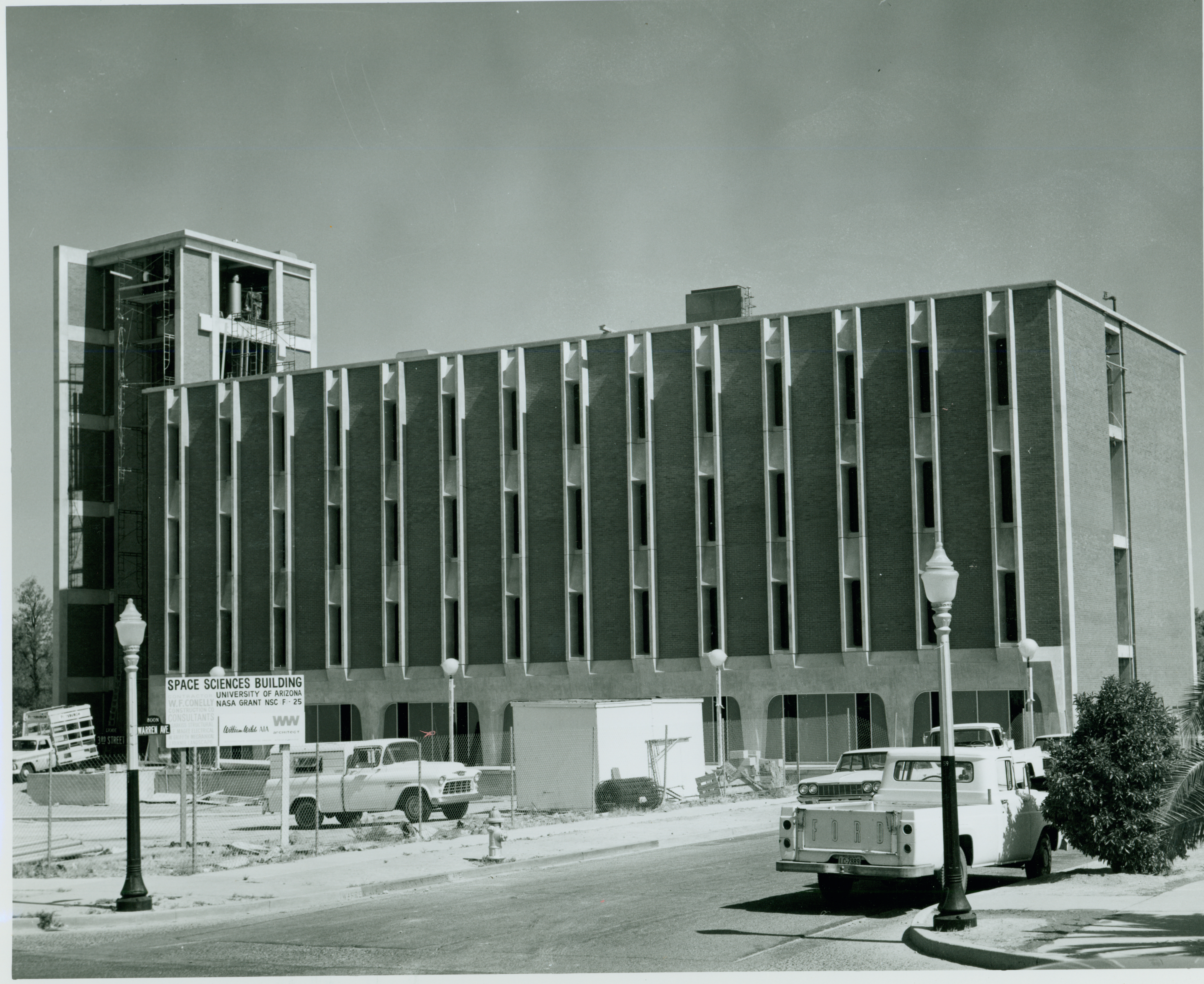
There was a conference here in Tucson called the Arizona Conference on Planetary Atmospheres, and as a graduate student who was working on the chemistry of Venus I came to the conference and presented a paper. Gerard Kuiper, the Head of the Department, was at the conference, and he invited me to come over and tour the lab. It was a fairly new building. It had been occupied only about three years; very up-to-date, beautiful astronomical facilities. He showed me the shops down in the basement where they processed mirrors and optics and so on.
That evening tour ended in his office. He had his office set up sort of like a church. There was a raised alter at the front of the room—a very long room—and he had a little living room set up at one end. There was a raised dais about a step high, where his desk was, down at the end of the room. Then he had the flag of Arizona and the flag of the United States on either side of his desk. You felt like saluting when you came into the room. I should have caught a clue from these circumstances that this was an unusual operation.
Charles Wood
Kuiper was very much interested in art. He studied to be a painter when he was young, and he always tried to have artists around him. In fact, he had a little cottage in the backyard of his house on Sawtelle Avenue, and he gave it free to a guy that I met, who was an artist. He wanted to have artists and art in his life. He was very interested in music and things like that. He was sort of the old fashioned gentlemen scholar, I think.
He also hired a sculptor, Ralph Turner. Ralph was hired to take the photographs of the Moon that we had from telescopes and from some spacecraft, and to make three-dimensional models of those objects—of craters, or of mountains on the Moon—and then he would have a light source that would have the light shining on his model the same angle it was for each of the photographs that we had.
He would continually change his model until it matched every photograph that he had, and then that would be an accurate model of that feature on the Moon. Then we could measure the angels, the slopes of the features, and the depths of them and whatnot.
It was a very unusual way of finding out about the topography of the Moon. If you go in the Lunar Lab, on the main floor there’s a grey model on the wall—it must be about six or eight feet across—and that’s one of Ralph’s, one of his models of a peak on the Moon. It’s still there.
Alika Herring was another one of these strange guys that Kuiper latched onto. He was from Hawaii, and he made his living doing two things. He played the Hawaiian steel guitar, and he made telescopes. He ground mirrors for telescopes and worked for a company that made telescopes for amateur astronomers.
He made a telescope for one of the Ranger spacecraft, I believe, that went to the Moon, and then he stayed on and he made drawings of the Moon using the photographs and using visual observations with some of the Lunar Lab telescopes. That was another sort of unusual thing, a throwback to the past. It used to be the way people studied the Moon a hundred years ago was by making drawings. Kuiper made the first really high-quality photographic atlas of the Moon, but he also was willing to have somebody who had keen eyesight and good telescopes to make drawings as well.
Harold Larson
I was one of the few people who could write a program in Fortran, and use the very few computers that existed. It was that combination of background and skills that allowed me to step in and take over Kuiper’s [airborne spectroscopy] project.
I remember asking him, “You know, I’ve never had…” I don’t know if I said this, but I didn’t think I could name the nine planets.
He said, “It doesn’t matter. You learn planetary science by doing it.”
To this day, the department says we don’t offer an undergraduate minor or major in planetary science because you should be good at something else. Be a good physicist, a good chemist, geoscientist, and you can pick up the planetary stuff on the job. Kuiper saw no problem with hiring me without any background in astronomy. In fact, it’s not been a limitation.
William Hubbard
I talked to Kuiper some about his philosophy of planetary exploration. He said, “What do humans do when they get to a new place? The first thing they do is look around. You have to be able to look around.”
I was trained as a traditional astrophysicist. Astrophysicists don’t look at pretty pictures. They look at data and they apply high-powered mathematics to analyze the data and infer basic physical processes. Just looking at pictures isn’t going to get you anywhere.
That was part of the, I might say contempt, that the astrophysicists had for planetary scientists back in those days, is that all they were doing was looking at pictures and they weren’t doing fundamental science.
You have to disagree with that when you start seeing pictures like the Cassini pictures which show such intricate physical processes; for example, the rings of Saturn. There’s so much beautiful physics being exhibited there, and certainly even in landforms on satellites. So I think that was a rather unenlightened point of view, which probably originated with just the low resolution of images available from spacecraft in those days.
Robert Strom
Even before we had the lunar orbiter, there was a program here which I was involved in to obtain high resolution telescopic images from the Earth. That was done right here in the Catalina Mountains, with a telescope that Kupier had built and was sponsored by NASA. We went up almost every night to photograph the Moon at the highest resolution we could and produced an atlas from that.